HIV remains one of the most searched health topics in the UAE, especially among people who may have experienced a recent exposure and are worried about possible symptoms. One of the most common questions is:
"How long after exposure do HIV symptoms appear?"
The answer is not always straightforward because HIV symptoms can vary from person to person, and some individuals may not experience symptoms at all during the early stages of infection.
In this UAE guide, we'll explain the typical HIV symptom timeline, early warning signs, testing windows, and when you should consider getting tested.
Understanding HIV Exposure
HIV (Human Immunodeficiency Virus) can be transmitted through contact with infected blood, semen, vaginal fluids, rectal fluids, or breast milk.
Potential exposure may occur through:
Unprotected sexual contact
Sharing needles or syringes
Exposure to infected blood
Certain medical or occupational incidents
It's important to remember that not every exposure leads to HIV infection, but timely testing is essential if you believe you may have been at risk.
How Long After Exposure Do HIV Symptoms Appear?
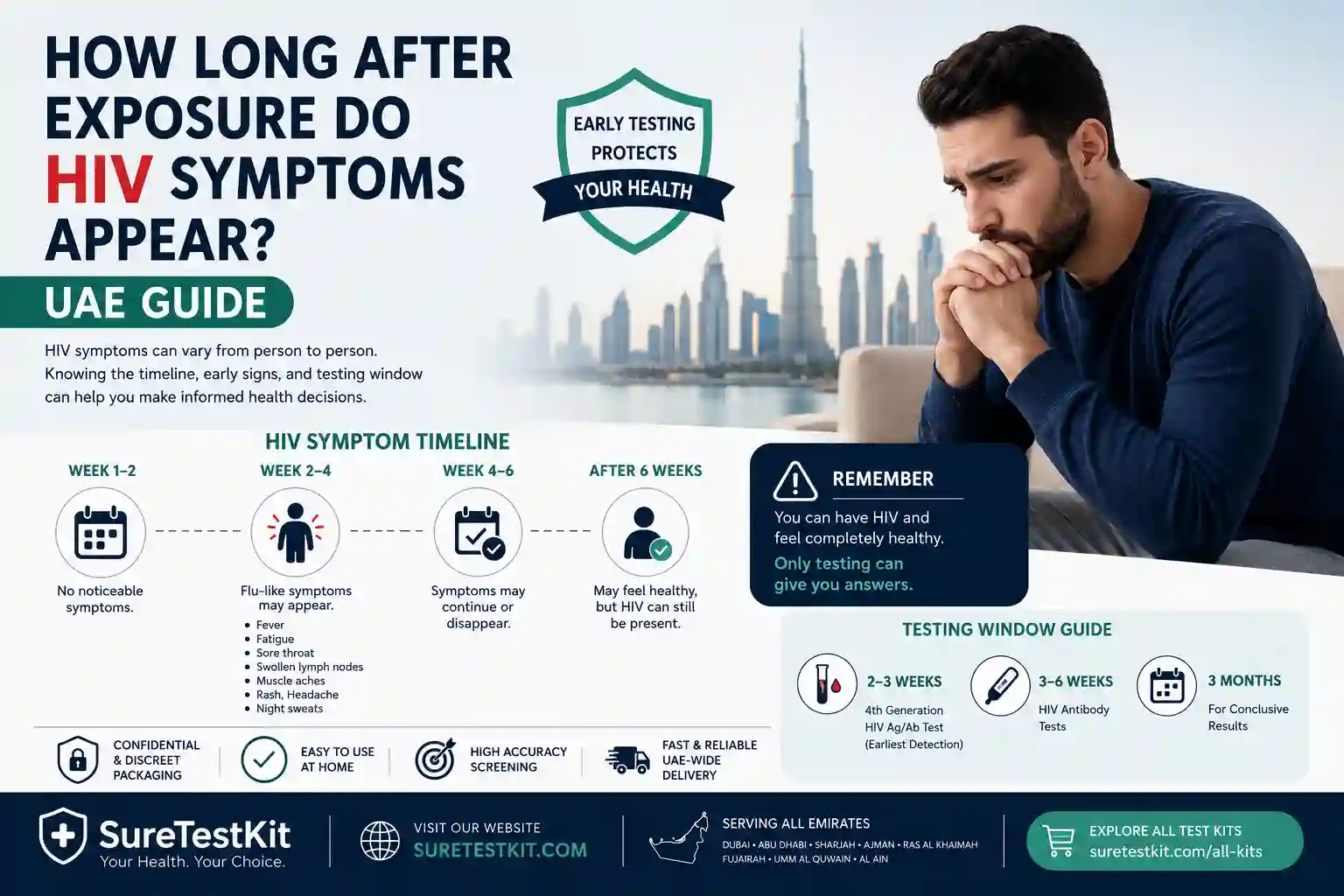
For many people, the first symptoms appear between 2 and 4 weeks after exposure.
This stage is often called Acute HIV Infection or Primary HIV Infection.
Some individuals may notice symptoms as early as 7–14 days after exposure, while others may not experience any symptoms for months or even years.
Typical HIV Symptom Timeline
Week 1–2 After Exposure
Most people experience no noticeable symptoms during the first week.
The virus begins multiplying inside the body, but symptoms usually have not developed yet.
Week 2–4 After Exposure
This is when many people develop symptoms similar to the flu.
Common symptoms include:
Fever
Fatigue
Sore throat
Swollen lymph nodes
Muscle aches
Joint pain
Headache
Night sweats
Skin rash
These symptoms occur because the body's immune system is reacting to the virus.
Week 4–6 After Exposure
Symptoms may continue for several days or weeks.
For some people, symptoms disappear completely even though HIV remains present in the body.
After 6 Weeks
Many individuals enter the clinical latency stage where they may feel completely healthy and symptom-free.
Without testing, a person may not know they have HIV.
Can You Have HIV Without Symptoms?
Yes.
Many people with HIV experience no noticeable symptoms during the early stages.
Some individuals remain symptom-free for years.
This is why healthcare professionals recommend testing based on exposure risk rather than relying solely on symptoms.
Common Early HIV Symptoms
The most frequently reported early HIV symptoms include:
Fever
Often one of the earliest signs.
Fatigue
Persistent tiredness without a clear cause.
Swollen Lymph Nodes
Particularly in the neck, armpits, or groin.
Skin Rash
Flat or slightly raised red areas may appear on different parts of the body.
Night Sweats
Excessive sweating during sleep.
Sore Throat
Often resembles a common viral infection.
Muscle and Joint Pain
Body aches similar to influenza.
HIV Symptoms vs Common Flu
Many people mistake acute HIV symptoms for seasonal flu.
Similarities include:
Fever
Fatigue
Sore throat
Muscle aches
However, HIV symptoms may also include:
Swollen lymph nodes
Persistent rash
Night sweats
Symptoms lasting longer than a typical cold
Symptoms alone cannot confirm HIV infection.
Only testing can provide accurate answers.
When Should You Get Tested?
Testing timing is extremely important.
Different HIV tests have different detection windows.
HIV Ab/Ag P24 Test Kit (4th Generation)
One of the earliest screening options available.
Product Link:
HIV Ab p24 Ag Test Kit
This advanced screening method can detect both HIV antibodies and the p24 antigen, helping identify infections earlier than antibody-only tests.
HIV 1/2 Antibody Test Kit
Product Link:
HIV 1/2 Antibody Test Kit
Used to screen for antibodies developed by the body's immune response.
HIV 1/2 Rapid Test Kit (ELISA)
Product Link:
HIV 1/2 Rapid Test Kit Elisa
Provides rapid screening with reliable performance when used according to instructions.
Should You Consider Broader STD Screening?
Individuals concerned about HIV exposure may also wish to consider screening for other sexually transmitted infections.
4 Panel STD Test Kit
Includes:
HIV
Syphilis
Hepatitis B
Hepatitis C
Product Link:
4 Panel STD Test Kit
7 Panel STD Test Cassettes
Product Link:
7 Panel STD Test Cassettes
11 Panel STD + STI Test Cassettes
Product Link:
11 Panel STD STI Test Cassettes
HIV Awareness Across UAE
Awareness and early screening are important for residents throughout:
Dubai
Abu Dhabi
Sharjah
Ajman
Ras Al Khaimah
Fujairah
Umm Al Quwain
Al Ain
Regular health screening supports informed healthcare decisions and personal wellbeing.
Frequently Asked Questions
Can HIV symptoms appear after 3 days?
Symptoms appearing within 3 days are uncommon. Most people who develop symptoms notice them between 2 and 4 weeks after exposure.
Can I have HIV and feel completely healthy?
Yes. Many individuals experience no symptoms during the early stages.
Is a rash always present?
No. Some people develop a rash while others never experience one.
Can symptoms alone diagnose HIV?
No. Symptoms can resemble many common illnesses. Testing is required for accurate screening.
Final Thoughts
The time between HIV exposure and symptoms varies from person to person. While many individuals experience flu-like symptoms within 2–4 weeks, others may not notice any symptoms at all.
Because HIV symptoms can be mild, temporary, or completely absent, testing remains the most reliable way to understand your status.
If you're considering screening, explore the available HIV and STD testing options at:
For additional information and healthcare screening resources, visit:
Early awareness, informed decision-making, and timely testing are important steps toward maintaining your health and wellbeing.
Disclaimer
This content is intended for informational purposes only and should not be considered a substitute for professional advice. Always consult with a qualified professional for specific concerns.